



Beyond oil & gold: mapping forex markets in turbulent times
April 7, 2026 at 7:40 AM
The financial world has understandably been captivated by the extraordinary surge in gold to above $5,000 in the first weeks of 2026 and the looming theme of "Energy Crisis 2.0" due to the closure of the Strait of Hormuz. But when the foundations of global trade are shaken and fear becomes the dominant currency, it is useful to have a look outside of the most volatile assets and inspect more opportunities outside of the overarching commodities trades. As we noted, the geopolitical risk premium has fully priced an apocalyptic scenario into safe-haven assets, begging the question of whether the "ultimate escalation" is actually the signal for a market reversal, especially for gold.
That said, a comprehensive market strategy cannot live on fear alone. Beyond the chokepoints of the Middle East and the vaults of the Gulf Cooperation Council, the global economy is quietly adapting. For the forward-looking investor, looking past the immediate shock of oil and gold reveals profound structural opportunities. In the following lines we aim to draw a map of the global financial markets throughout and beyond the crisis.
The forex market impact: flight to safety and energy sensitivity
The current forex landscape is being dictated by two main factors: safe-haven capital flows and terms-of-trade shocks (specifically, the net energy import/export balance of a country). Furthermore, the inflationary spike caused by $115+ oil is forcing markets to reprice central bank policy. The US Federal Reserve is now expected to hold rates higher for longer to combat energy-driven inflation, widening yield differentials in favor of the US Dollar, while central banks in heavily impacted regions may be forced to choose between defending their currencies or supporting failing economic growth.
Currencies That Benefitted
US Dollar (USD): The Greenback is the undisputed winner in this environment. It benefits from a dual tailwind: immense safe-haven demand amid global uncertainty and structural energy independence. Because the US is a net exporter of crude oil, its economy is highly insulated from the terms-of-trade shock devastating other regions. Furthermore, the inflationary impact of high oil keeps the Fed ready to hike rates, therefore maintaininghigh US yields and an elevated US dollar.
Canadian Dollar (CAD): As a major oil exporter, Canada experiences a massive positive terms-of-trade shock when crude prices spike. The CAD benefits directly from the surge in global energy prices, making it one of the strongest performers outside of traditional safe havens.
Swiss Franc (CHF): The CHF is experiencing immense safe-haven inflows due to the geopolitical panic in the Middle East. While the Swiss National Bank (SNB) is keeping a close eye on the Franc's strength (which hurts Swiss exporters), the currency remains a primary destination for risk-averse European capital.
Currencies That Sufferred
The Japanese Yen (JPY) and South Korean Won (KRW): Asian economies are taking the brunt of this shock, as approximately 90% of the oil passing through the Strait of Hormuz heads to Asia. Japan and South Korea are entirely dependent on imported energy. The soaring cost of oil severely damages their trade balances, bleeding their currencies. The JPY, already dealing with structural weaknesses, has been battered (reaching almost 160 to the USD) as the energy import bill for the country skyrockets.
The Euro (EUR) and British Pound (GBP): Europe is highly exposed to Middle Eastern LNG and broad global energy prices. The spike in energy costs resurrects the acute stagflation fears seen in recent years - depressing industrial growth while keeping inflation sticky. This severely handicaps the European Central Bank (ECB) and the Bank of England (BoE), making their currencies highly vulnerable against the USD.
Emerging Market Asian Currencies (INR, THB, PHP): Similar to the JPY and the KRW, nations like India, Thailand, and the Philippines run heavy energy deficits. Widespread fuel rationing and inflation fears in these countries are driving aggressive capital flight, putting massive depreciation pressure on their local currencies.
As the conflict is escalating
While the Strait of Hormuz remains contested and oil prices are structurally supported above or near $100, the playbook should focus on long energy/long safe-haven dynamics against energy importers.
USD/JPY: This is the most direct macroeconomic expression of the conflict. Traders are buying the ultimate energy-independent safe haven (USD) and shorting the most vulnerable, energy-dependent economy (JPY). The widening rate differentials (Hawkish Fed vs. trapped Asian central banks) add a strong carry-trade advantage.
CAD/JPY: Traders who want to isolate the oil shock without taking on USD exposure, have been buying the Canadian Dollar against the Japanese Yen is a pure terms-of-trade play. CAD tracks the price of crude upward, while JPY is mechanically sold off to fund expensive oil imports.
EUR/CHF: A proxy for European stagflation risks, amid a Eurozone economy suffering under the weight of high energy costs, European capital continues to leak across the border into the safe-haven Swiss Franc.
When the conflict quiets down
Historically, geopolitical risk premiums are priced out of markets incredibly fast once a credible de-escalation or a ceasefire are established. When the prospects for the Strait of Hormuz to reopen and oil prices begin to normalize (dropping back toward the $70-$80 range), the trade is to aggressively fade the extremes.
USD/JPY and USD/KRW: As oil prices collapse, the massive import premium crushing the Yen and the Won are evaporating. Their trade balances will rapidly heal if prices for energy quiet down. Simultaneously, a drop in oil may ease US inflation fears, leading markets to price in Fed rate cuts again, compressing the yield gap and sending USD/JPY sharply lower.
AUD/USD and NZD/USD: High-beta commodity currencies (like the Australian and New Zealand Dollars) have been pressured by a global "risk-off" environment and fears of a global recession. But if the geopolitical cloud lifts and global growth prospects improve, capital will flood out of the safe-haven USD and back into these higher-yielding, risk-on currencies.
EUR/USD: The removal of the energy tax on the European economy may lead to a rapid relief rally in the Euro. With stagflation risks receding, European equities are likely to attract capital once again, and the EUR mayappreciate as the USD loses its safe-haven luster.
CAD/JPY: A de-escalation may lead to a direct reversal of the ongoing conflict trade. As crude prices gap down on the news of peace or unhindered shipping, the CAD loses its commodity premium while the JPY rallies on cheaper energy import costs.
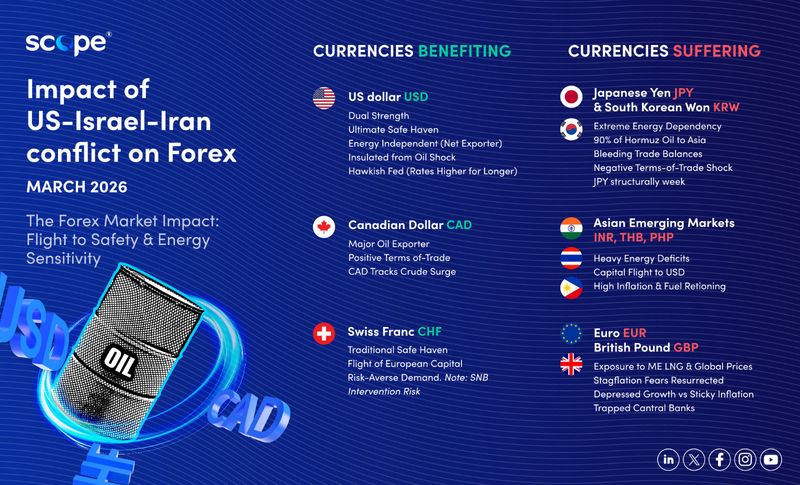
Impact on major currencies from Middle East conflict so far
Inevitable de-escalation, or endless tension?
With the recent events in the Middle East putting to the test the global economic interconnectedness, there are very few options left for the powers that be, to wrap the looming economic crisis. Trump’s administration has started the conflict with unclear goals and without congressional approval, and the U.S. legal system and the power of the purse which is still with the U.S. Congress, may challenge the effort altogether. The costs of waging war will inevitably loom over the U.S. president’s geopolitical agenda, and an abrupt funding problem, could put a dent in Donald Trump’s plans.
If the $5,000 gold price truly represents the peak of market fear, the "news" that macro-traders will soon sell, then capital may be preparing to rotate. The prospects for a resolution of the geopolitical conflict, or even just the market's acclimation to a new normal, typically sparks a powerful resurgence in risk assets that drive fundamental transformation, just like the AI-centered US stock market has been over the past several years.
In the meantime, currency markets have their ways of quickly adapting to the flows of the global economy. More volatility and opportunities across the FX board will open and close many more times this year. Regardless of what’s your opinion about the future of the U.S. dollar as a reserve currency, the energy-heavy stress induced in Japan and Korea on the Asian side, and the EUR and the GBP in Europe, reacting timely to the news-flow will be critical to identifying future trends.
This material is a marketing communication provided for informational purposes only and does not constitute investment advice, recommendation, or an offer or solicitation to trade. Any market analysis, opinions, or forecasts are based on publicly available information and do not constitute independent investment research. Past performance and forecasts are not reliable indicators of future results. Scope Markets accepts no liability for any loss arising from reliance on this information.
Related Articles

Technical Scope: No changes in technicals, or fundamentals!
By Mohanad Yakout
Welcome to today’s edition of The Technical Scope, your twice-weekly guide to the evolving landscape of global markets through the lens of technical a...
Read More
Market Analysis
Technical Analysis
Swing Trading

Technical Scope: The Strong Dollar Effect
By Mohanad Yakout
Welcome to today’s edition of The Technical Scope, your twice-weekly guide to the evolving landscape of global markets through the lens of technical a...
Read More
Market Analysis
Technical Analysis

Technical Scope: Markets stuck in a sideways range
By Mohanad Yakout
Welcome to today’s edition of The Technical Scope, your twice-weekly guide to the evolving landscape of global markets through the lens of technical a...
Read More
Market Analysis
XAUUSD
USDJPY
US 500
Trend Following
Technical Analysis
Swing Trading
Support And Resistance

Stop Trading the News, Start Trading the Oil Cargo
By Victor Golovtchenko
When you see a Reuters headline that tells you OPEC+ is "completing the series of symbolic quota hikes," what exactly are you trading? When the Irania...
Read More
Market Analysis
Oil
US Oil
UK oil
WTI
Brent Crude
Trading

Technical Scope: Markets Mixed Ahead of Key Developments
By Mohanad Yakout
Welcome to today’s edition of The Technical Scope, your twice-weekly guide to the evolving landscape of global markets through the lens of technical a...
Read More
Market Analysis
XAUUSD
USDJPY
US 500
Trend Following
Technical Analysis
Swing Trading
Support And Resistance
Technical Scope: Key Levels & Market Outlook ahead of NFP Data
By Mohanad Yakout
Welcome to today’s edition of The Technical Scope, your twice-weekly guide to the evolving landscape of global markets through the lens of technical a...
Read More
Market Analysis
Chart Patterns
Candlestick Patterns
Day Trading
GBPUSD
Gold
NFP
Non Farm Payrolls
EURUSD
Oil
S&P 500
US 500
USDJPY
XAUUSD
The state of Hormuz: oil price action is not the story
By Victor Golovtchenko
Another month, another week, another batch of headlines, and new all-time highs for US stock markets might not be the news one awaits when they see th...
Read More
Market Analysis
Oil
WTI
Brent Crude
Strait of Hormuz
UAE
OPEC
Technical Scope: Key levels to watch for on JPY pairs
By Mohanad Yakout
Welcome to today’s edition of The Technical Scope, your twice-weekly guide to the evolving landscape of global markets through the lens of technical a...
Read More
Market Analysis
Technical Analysis
Day Trading
Chart Patterns
EURUSD
GBPUSD
Crude Oil
S&P 500
Gold

Beyond oil & gold: sector rotation from AI-centric to energy-centric
By Victor Golovtchenko
The vulnerability of the Strait of Hormuz which is handling 20% of global oil flows and a massive share of Qatar’s liquified natural gas (LNG) exports...
Read More
Market Analysis
Stocks
Energy
Tesla